
Caring for yourself while caring for others

What does it actually mean to care for oneself? Some of the first words that come to mind are personal integrity, to feel oneself and to listen to oneself.  One of the great gestalt therapists was once asked: Who was more important the client or the therapist? The answer was the therapist. It is a provocative way of seeing it, but the point is true. If the therapist does not see him/herself as the most important, it is not possible to help the client fully. 

2017-12-16T00:36:01+00:00October 26th, 2017|General Psychology|

Flying or Falling

What is it that lets a work group function optimally? What promotes the completion of the task, an atmosphere conducive to cooperation, the solution of conflicts and the further development of the group and of its individual members?  Many models have been constructed at various times to answer these questions. BODYnamic's answer is a model consisting of eight necessary functions to be maintained by a leader (leader functions) or as a group (group functions). Hence the name: F8. Associations to the F16 fighter bomber are not out of place here: A "crash landing" cannot always be avoided, but the F8 model generally "keeps you flying" when used consistently. 

2017-12-19T20:52:18+00:00October 23rd, 2017|General Psychology|

Working around Developmental Defenses

Since a traumatic experience is essentially one of disintegration, it is understandable that it would bring out any pre-existing defenses. It becomes important then, for SE practitioners to learn how to spot these defenses and work around them. Otherwise, the SE process in general, and self-regulation in particular, will be hindered. The purpose of this note is not to teach people how to work developmentally. The purpose is rather, to give SE practitioners some ideas about how they might work around the developmental defenses that most often manifest in SE sessions.

2017-10-26T19:58:25+00:00October 22nd, 2017|Developmental Psychology|

Shapes of Experience

This chapter compares findings in developmental neuroscience and infant research, from children from birth to two years old, with five basic somatic character structures derived from the slightly varied descriptions of development in three different somatic character systems: Bioenergetics, Hakomi, and Bodynamics.

2024-04-19T20:08:10+00:00October 22nd, 2017|Developmental Psychology|

Developmental Shock Trauma

Shock trauma can, of course, occur at any time in one's life. Thus it might occur within developmental stages (pre-birth through adolescence). The focus in this workshop is on trauma that occurs within particular developmental stages -- the attachment stages: Existence (2nd Trimester to 3 months): Need (1 month to 1.5 years of age); and Autonomy (8 months - 2.5 years). During these periods, most of the infant's experience is in the sensory motor realm. Spoken language is barely available, and the limbic and cortical portions of the infant's brain are not fully developed.

2017-11-12T06:20:00+00:00October 22nd, 2017|Trauma|

The Bodymap – A precise diagnostic tool for Psychotherapy

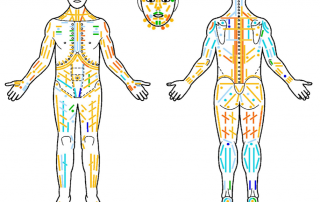
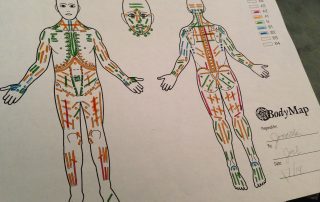
In this article we introduce readers to the Bodymap, a precise diagnostic tool developed as a part of Bodynamic Analysis. The Bodymap is a concise visual format for displaying and analyzing psychological information stored in the muscles. The ability to measure muscle responses and access the historical information they contain makes a developmental analysis in terms of psychological character structures more concrete and less metaphorical. We also introduce ten “Ego Functions” (e.g. grounding and reality testing, centering, etc.) that are used to understand human functioning.

2024-04-19T20:07:59+00:00October 21st, 2017|Bodymap|

Bodymap Reading & Interpretation

In Bodynamic Analysis, we use a Bodymap as a starting point for the evaluation of the personality of the client. It also helps us find out how they might benefit from different kinds of therapy. On the Bodymap form, which is a drawing of a figure of the human front and backsides, we make a color-coded depiction of the muscle responses of almost all the muscles of the client. By muscle response, we mean the elasticity of each muscle, as measured by palpation. We differentiate nine degrees of response: 4 degrees of hypo-response, 4 degrees of hyper-response, and 1 neutral response.

2017-12-29T21:37:29+00:00October 20th, 2017|Bodymap|

The Peak Interview – as used in Coaching

The Peak Interview - as used in CoachingBy: Bent Warming-Rasmussen, Erik Jarlnæs, Jesper Raalskov Summary The Peak Interview is a particular effective method to make unconscious human resources conscious. The client (interviewee) is interviewed about a self-elected personal successful experience. The therapist/ Coach (interviewer) asks about the process that led to this success. Hereby a number of factors, which led to the success, are identified. The client hereby gets an awareness of the success and which conditions and connections that led to [...]

2021-02-20T16:10:21+00:00October 17th, 2017|General Psychology|

Supervision with a Bodily Anchor

After many years as supervisor to psychologists and other related groups I got an impulse to share some of my notices and ideas in a larger forum. There are many aspects in working with supervision. It is not my intention to overview this total area. I simply want to share experiences in using specific effective tools from my practice as supervisor.

2017-12-22T19:38:31+00:00October 16th, 2017|General Psychology|
Go to Top