
The Bodynamic System: A Practical Map of Human Development
Many of the patterns that shape how you feel, relate, make decisions, and respond under stress were learned long before you could consciously understand them. When these patterns operate outside your awareness, you may find yourself repeating the same conflicts, losing contact with what you need, or feeling stuck in reactions that no longer serve you.
The Bodynamic System offers a practical map for understanding how your psychological development is connected to your body. Its interrelated models help you recognize the origins of your patterns, appreciate the defenses that once protected you, identify the resources you already possess, and discover skills that may still need support.
By bringing greater awareness to your development, feelings, identity, relationships, and embodied psychological abilities, these models can help you make clearer choices, build healthier connections, and meet life with greater confidence, flexibility, and self-understanding.
The Bodynamic System includes a wide range of interconnected models for understanding human development, character, relationships, trauma, and embodied psychological functioning.
The following five foundational models provide an accessible starting point for exploring the system. Each model describes a necessary part of the whole: how developmental stages shape personality, how psychological skills are formed through the body, how feelings organize experience, how identity develops, and how inner conflicts become repeating patterns. Together, these models provide a practical framework for understanding both the origins of our difficulties and the resources we can strengthen to create lasting change.
Developmental Stages
& Character Structures
A child’s psychological and emotional development unfolds through seven overlapping stages, spanning from the second trimester in utero to roughly age twelve, each named for a core emotional theme and the right the child works out during that window: Existence, Need, Autonomy, Will, Love/Sexuality, Opinion, and Performance/Solidarity. Each stage gives rise to a corresponding character structure that develops along a spectrum set by the type and timing of nurture the child receives.
Chronic missatunement occurring early in a stage tends to produce resignation—a giving-up of impulses and skills that leaves a felt sense of emptiness (the early or collapsed position)—while stress occurring later tends to produce a holding-back and muscular armoring, an often rigid or angry stance (the late position). Between these lies the healthy, resourced position, in which the child maintains deep connection while developing the skills appropriate to that stage.
The resulting structures are understood not as defenses to be broken down but as creative survival strategies, born from the child’s drive to preserve mutual connection—sometimes at the cost of individual dignity—that can be gently understood and resourced.

Ego Functions
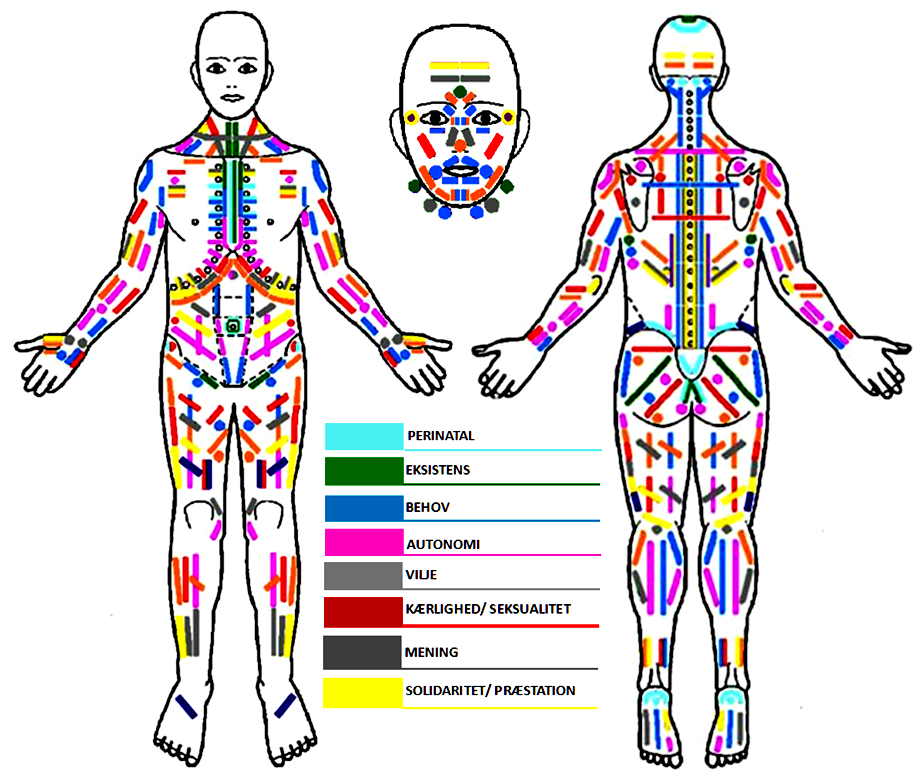
At a practical level, ego functions are the psychological skills that help us manage everyday life: sensing ourselves, staying grounded in reality, regulating emotions and energy, setting boundaries, connecting with others, asserting ourselves, thinking clearly, and balancing our own needs with the demands of relationships and groups. These abilities are not understood as purely mental capacities; they are learned through the body during development.
As a child moves, reaches, pushes away, stands, breathes, receives support, and interacts with caregivers, specific muscles and connective tissues participate in learning these psychological functions. Much of this learning happens before language and conscious reflection, so the skills become encoded somatically and operate automatically or unconsciously.
Later in life, we may therefore “know” how to protect ourselves, connect, organize energy, or hold our position through bodily patterns before we can explain them in words. When an ego function is underdeveloped or defended, the difficulty may appear both psychologically and physically; strengthening the associated bodily experience can help the person gain more conscious access to the skill and use it more freely in real-life situations.
Layers of Feelings
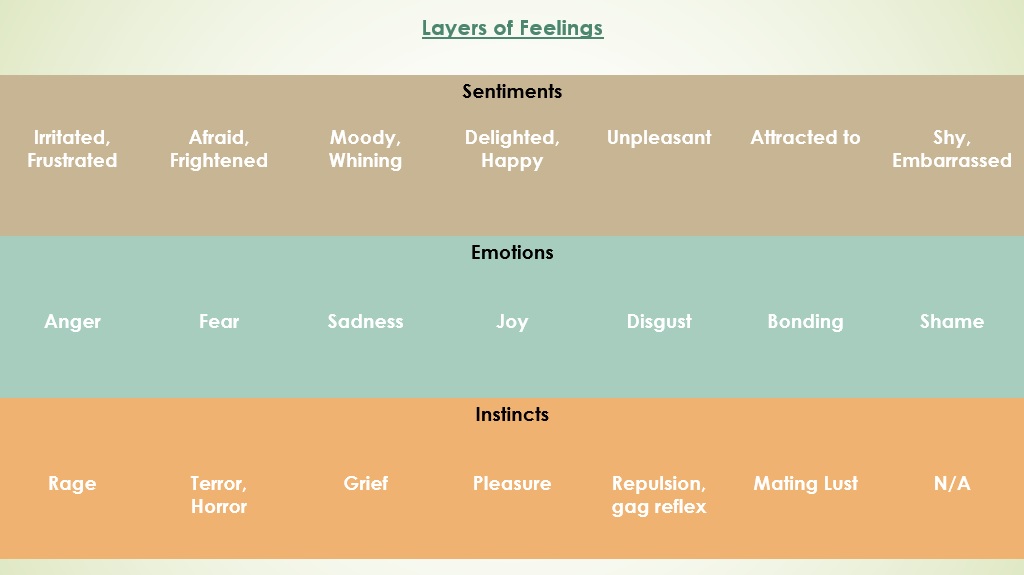
Feelings are organized into three interconnected layers: instincts, emotions, and sentiments.
- Instincts are our most basic survival responses, activated when the nervous system perceives a threat to life or physical safety.
- Emotions are relational feeling states that we share with other mammals; they help us connect, communicate, protect what matters, respond to loss, and navigate our relationships with others.
- Sentiments are more complex and often longer-lasting states shaped by thoughts, interpretations, social norms, personal values, and previous emotional experiences.
Learning to distinguish these layers is important because sentiments can sometimes cover more immediate emotions, while character structure defenses may inhibit, redirect, or replace emotions that were not adequately supported within the family system. When emotions are suppressed, held outside awareness, or covered by other feelings, we may lose access to valuable information about our needs, boundaries, relationships, and desired direction in life. Differentiating emotions from instincts is also essential when distinguishing an acute shock or survival state from the emotional experiences of ordinary daily life.
Ego Aspects
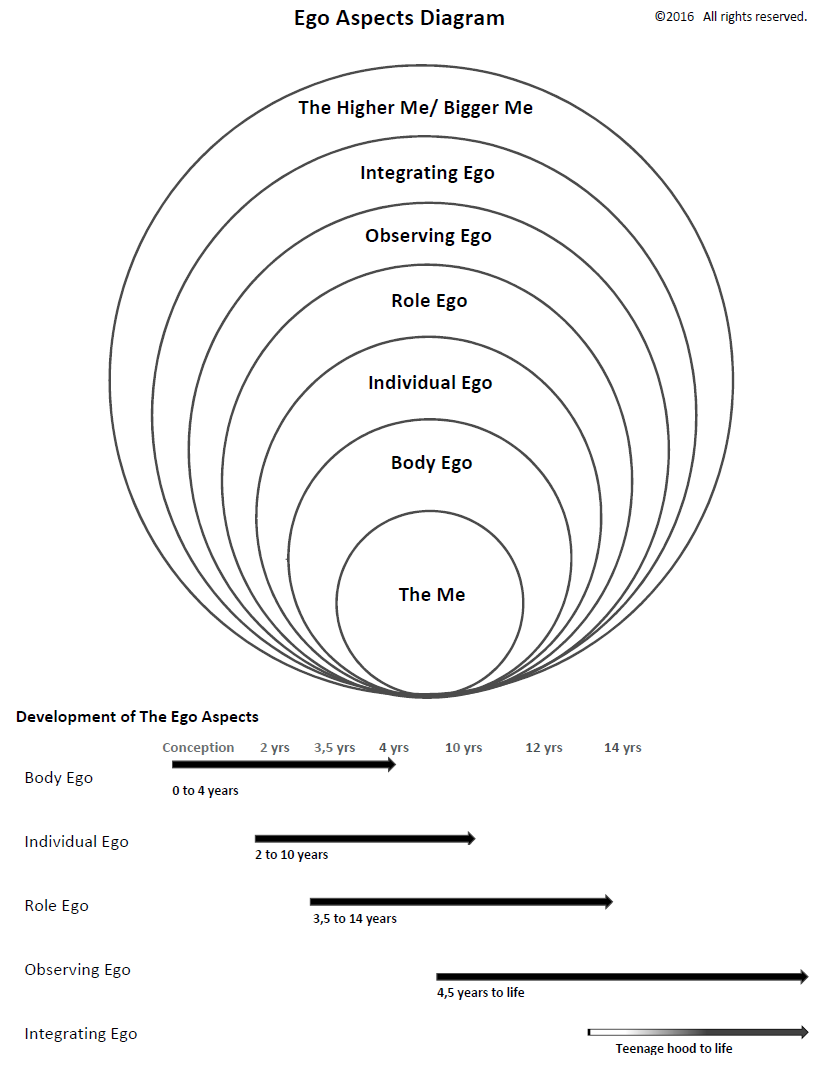
Ego aspects are interrelated layers of identity that organize how we experience ourselves and function in the world.
- The Body Ego is the foundation of embodied identity: “I sense, I feel, and I inhabit my body.”
- The Individual Ego supports the experience of being a distinct person with personal preferences, impulses, desires, and intentions: “I like, I want, and I choose.”
- The Role Ego enables us to understand and inhabit the different roles we hold within families, relationships, groups, and society, including the norms and values connected with those roles.
- The Observing Ego gives us the capacity to notice our sensations, emotions, thoughts, actions, and impact on others while an experience is occurring.
- Beginning in adolescence, the Integrating Ego gradually brings these aspects together into a more coherent and mature adult awareness.
Although each aspect has a particular developmental starting point, they continue to develop throughout life and together form the core of our experiential sense of self.
Bodyknot
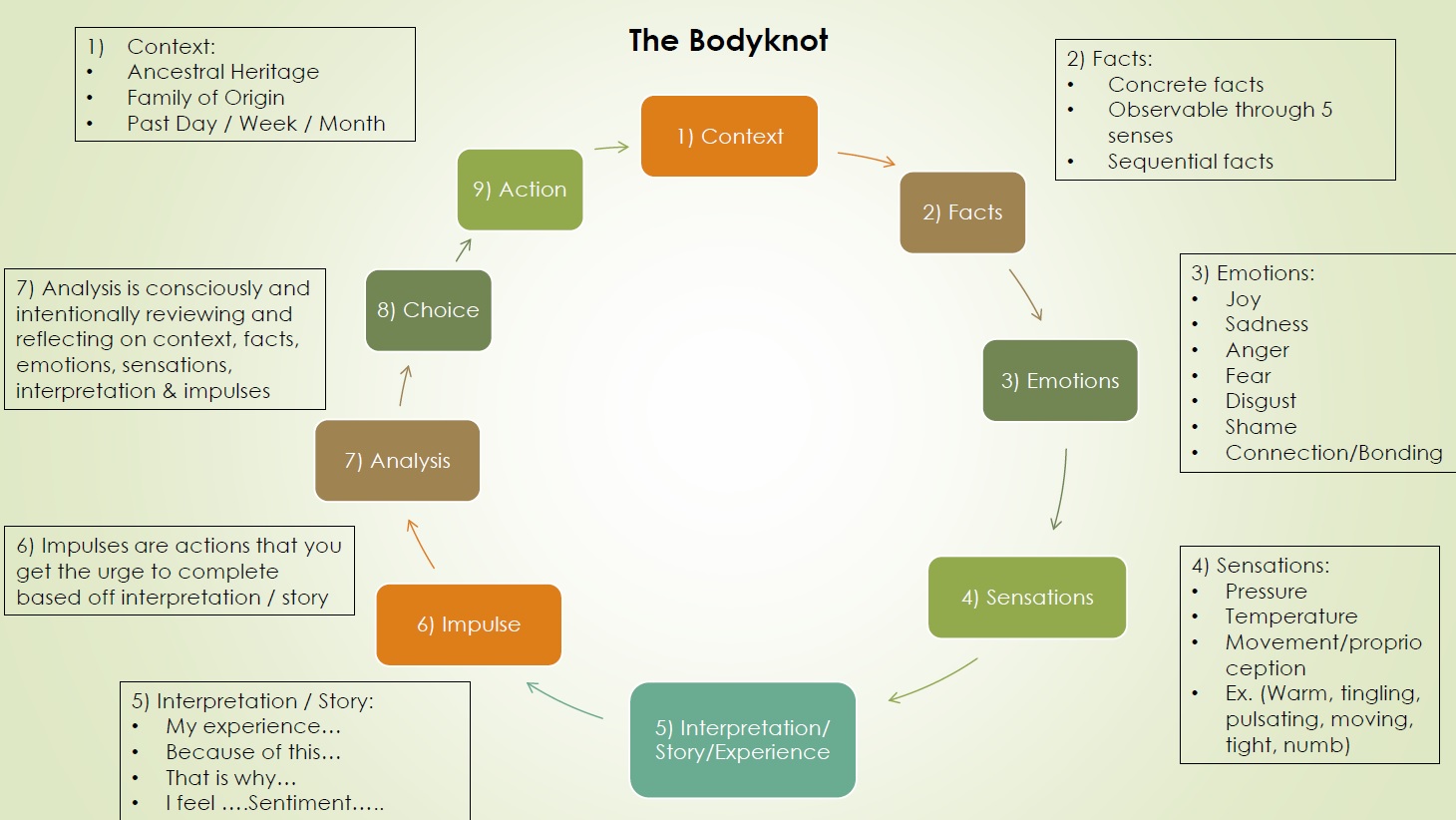
The Bodyknot is a practical model for understanding and navigating personal experiences, communication difficulties, and conflicts. When people feel stuck in a repeating pattern of thinking, feeling, or behaving, they may be moving automatically through only part of their experience—perhaps reacting to an interpretation as though it were a fact, acting on an impulse without considering its consequences, or suppressing a sensation or emotion that contains important information.
The Bodyknot helps separate and clarify the different elements involved: the context of the situation, observable facts, emotions, bodily sensations, interpretations, action impulses, possible consequences, choices, and actions.
By identifying which elements have been confused, skipped, or left outside awareness, a person can gain a more complete understanding of what is happening and access a wider range of psychological resources. This strengthens the ability to reality-test assumptions, communicate clearly, make conscious choices, and take actions that are more consistent with one’s needs, values, and present circumstances rather than automatically repeating patterns from the past.



Bodynamic GPT
https://chatgpt.com/g/g-GHM9K5gRs-bodynamic-gpt
Books exploring Bodynamics
3x amazon books